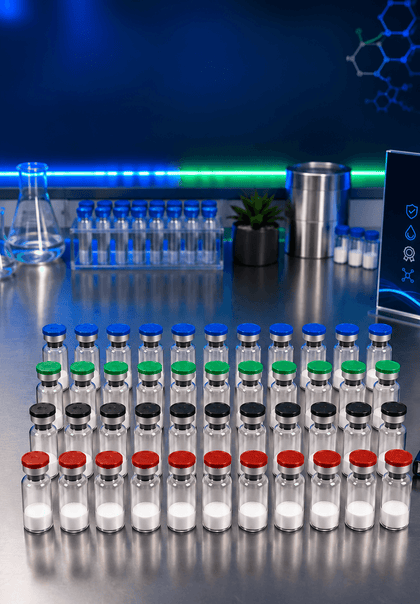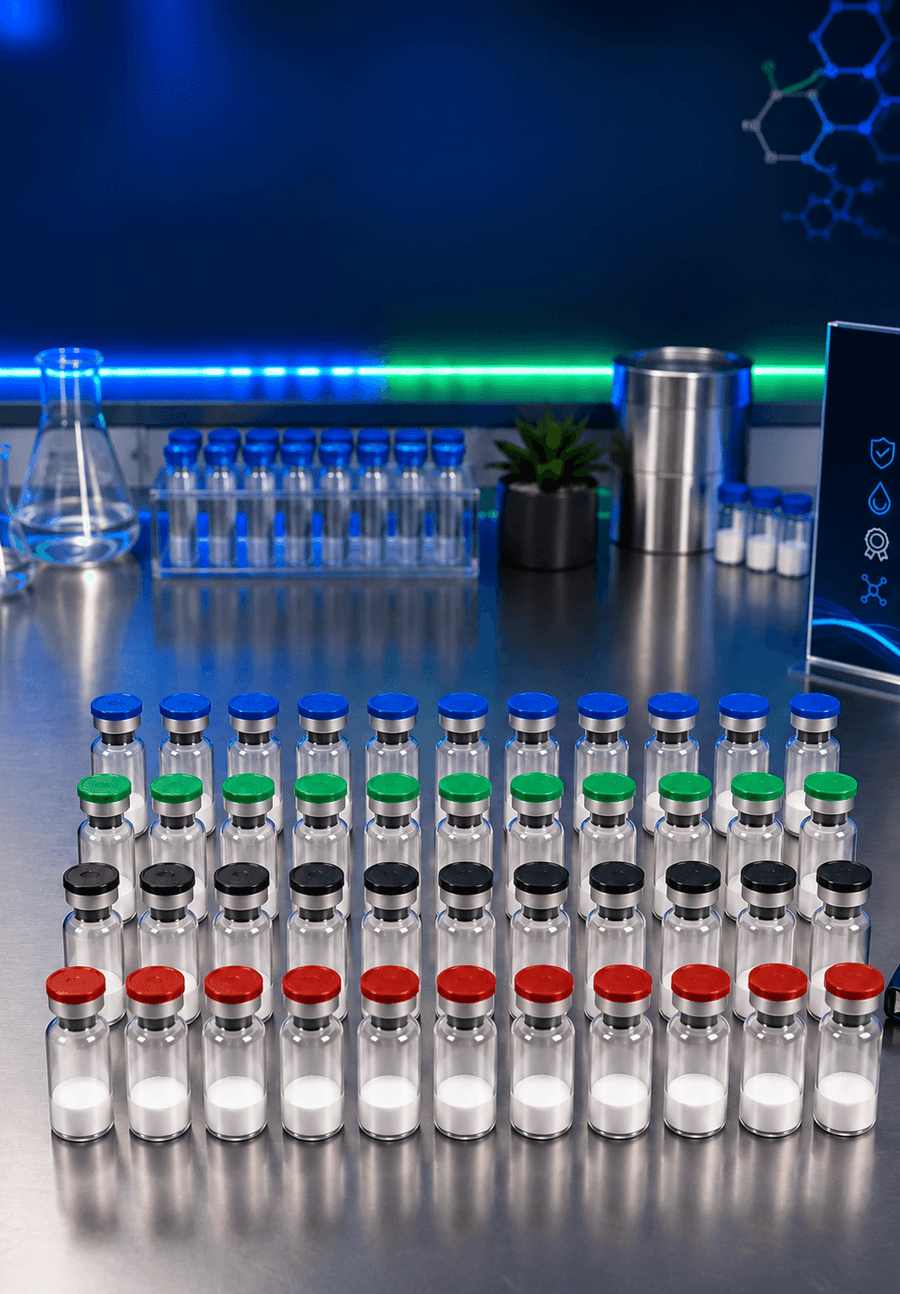
GHK-Cu 100mg x 10 vials
Orders before 2:00 PM CT ship the same business day · Batch COA · Shipping
Details
GHK-Cu: 10-Vial Kit for Laboratory Research
GHK-Cu 100 mg x 10 vials is a 10-vial research kit from VendPeptides: GHK-Cu, copper tripeptide-1 complex, supplied for laboratory research. Every lot ships against an independent third-party certificate of analysis matched to the batch number on the vial, and the certificate — not this page — is the source of purity, identity and net-content values for the material you receive.
This page sets out what the listing states, what the published literature says about GHK-Cu, how the material is handled in a laboratory, and how it compares with related compounds in our Longevity Research Peptides collection. For research purposes only. Not for human consumption.
What Is GHK-Cu?
GHK-Cu is a 1:1 complex of the tripeptide glycyl-L-histidyl-L-lysine with copper(II). The GHK sequence occurs endogenously in human plasma and has a high affinity for copper; the complex is the form most often used in laboratory work.
The lyophilized solid is a distinctive blue, and so is the reconstituted solution. That colour is the intact Cu(II) complex and doubles as a free stability indicator: fading toward colourless means the complex is dissociating.
Specification at a Glance
| Attribute | Details |
|---|---|
| Product | GHK-Cu 100 mg x 10 vials |
| Compound | GHK-Cu |
| Class | copper tripeptide-1 complex |
| Formats listed | 100 mg per vial, 10 vials |
| Nominal strength (listing) | 100 mg |
| Pack | 10 vials per kit |
| PubChem entry | GHK-Cu — CID 139035031 |
| Molecular formula (PubChem) | C14H21CuN6O4- |
| Molecular weight (PubChem) | 400.90 g/mol |
| Purity | Lot-specific; reported on the batch certificate of analysis (RP-HPLC) |
| Salt form / net content | Not stated on the listing; see the batch documentation |
| Intended use | For research purposes only. Not for human consumption. |
| Certificate of analysis | Batch-matched COA library |
Research Applications of GHK-Cu
The published research on GHK-Cu is summarised below by application area. These are contexts in which the compound appears in the literature, not claims about outcomes; the model, the endpoint and the concentration belong to the researcher's protocol.
Fibroblast and collagen assays
Dermal fibroblast culture, collagen synthesis and MMP expression.
Gene-expression studies
Widely used in transcriptomic profiling of cultured skin cells.
Copper-transport models
Paired with copper-free GHK to separate peptide from metal effects.
How GHK-Cu Works: Mechanism in the Published Literature
Published research examines GHK-Cu in gene-expression profiling, dermal fibroblast culture, and collagen and metalloproteinase expression assays. Copper delivery to cells is part of the proposed activity, which is why the copper-free GHK peptide is a useful control.
Reconstitution and Handling of GHK-Cu
This section describes laboratory handling of a lyophilized research reagent. It is not a dosing instruction, and no quantity for use in any organism is published here or anywhere on this site.
Dissolves readily to a blue solution. A pale or colourless solution indicates the complex has broken down; do not use it.
General practice for every lyophilized vial in our range: allow the sealed vial to reach room temperature before opening, so humid air does not condense onto the cake; introduce the solvent slowly against the inner wall rather than onto the powder; let it stand for two to five minutes; swirl, never shake or vortex. Label the vial with compound, concentration, solvent and date. Our reconstitution guide covers the method in full.
Safety, Compliance and Precautions
Research use only
For research purposes only. Not for human consumption. This is a research chemical for in-vitro and laboratory work by qualified researchers. It is not manufactured to the sterility, endotoxin or particulate standards of a finished pharmaceutical, and a high HPLC purity figure says nothing about those. It must not be administered to humans or animals.
No dose is published, anywhere
Concentration and quantity for any experiment are set by the researcher's institutional protocol. This page states the nominal milligrams per vial from the listing and nothing about amounts for use in any organism; our support team will decline to answer such questions.
Laboratory handling
Handle lyophilized powder with gloves and eye protection in a clean area; avoid generating dust. Treat reconstituted solutions as laboratory chemicals: label, refrigerate, aliquot, and dispose of through your institution's chemical-waste route.
Regulatory status
Research chemicals may lawfully be sold for laboratory research in the United States; they are not approved drugs. Some compounds carry additional restrictions in some jurisdictions, and international buyers are the importer of record. See Are research peptides legal?.
Storage and Shelf Life
Sealed and lyophilized: −20 °C for long-term storage, or 2–8 °C for several months, protected from light and moisture. Lyophilized peptides tolerate ambient temperature for the duration of domestic transit. After reconstitution: 2–8 °C, protected from light, aliquoted rather than repeatedly freeze-thawed. The listing does not state a shelf life for this lot; the certificate of analysis does. See the storage guide.
GHK-Cu Compared With Related Research Compounds
These are the compounds most often run alongside GHK-Cu in the same research area. Each is a different molecule with its own listing and certificate; none is a substitute for another, and blends do not let you attribute an effect to one component.
| Product | Class | Formats listed | Typical research context |
|---|---|---|---|
| AHK-Cu Peptide Powder | copper-complexed tripeptide (Ala-His-Lys) | single format | Comparative copper-peptide studies |
| BPC-157 | synthetic pentadecapeptide (Body Protection Compound 157) | 5Mg Vial, 10Mg Vial, 5Mg Kit 50Mg, 10Mg Kit 100Mg | Angiogenesis and VEGFR2 signalling |
| Semax 10mg | ACTH(4-10) heptapeptide analogue | 10Mg Vial, 10Mg Kit 100Mg | Neurotrophin expression |
| Selank 10mg | synthetic tuftsin analogue heptapeptide | 10Mg Vial, 10Mg Kit 100Mg | Neuronal culture markers |
Which to choose: Choose GHK-Cu when the protocol calls for this compound specifically. Choose the single vial to qualify a lot before committing to a kit, and the 10-vial kit when the same lot is needed across a series of experiments, because a kit ships from one batch with one certificate.
What a Good Certificate of Analysis Looks Like
Every lot ships against an independent third-party certificate matched to the batch number on the vial. Check four things when it arrives: the batch number on the certificate is the one on your vial; the RP-HPLC trace shows one dominant, symmetrical peak rather than a cluster of satellite peaks; the mass-spectrometry line reports an observed mass consistent with the compound; and the testing laboratory named is not the synthesis partner. Purity is the peak-area percentage of that trace and does not describe net peptide content by mass, which is reported separately where available. Look any batch up in the COA library.
When Not to Use a Lot, and When to Contact Us
Do not use material whose batch number does not resolve to a certificate, whose lyophilisate has collapsed into a sticky or discoloured mass (moisture ingress), or whose reconstituted solution is cloudy or holds visible particulates after standing. A GHK-Cu-containing solution that has faded from blue toward colourless has lost its copper complex and should be discarded. Photograph the vial and contact us within seven days of delivery: transit damage, certificate mismatch and out-of-specification material are replaced or refunded in full. See our refund policy.
Frequently Asked Questions
What is the difference between GHK-Cu and GHK?
GHK is the bare tripeptide; GHK-Cu is the same peptide complexed with copper(II). We list both: the copper-free peptide is the usual control in copper-dependence experiments.
Why is the powder blue?
The colour is the intact copper(II) complex. It is expected, and it is the quickest visual check that the material has not degraded.
What does 99% purity mean, and where is it stated?
Purity is the peak-area percentage of the target compound in a reverse-phase HPLC chromatogram at UV 214 nm. It is a lot-specific value reported on the certificate of analysis for the batch number on your vial; this page does not assert a purity for your lot, the certificate does.
Is this for human or animal use?
No. For research purposes only. Not for human consumption. It is a laboratory research chemical and is not intended to diagnose, treat, cure or prevent any condition.
How fast do orders ship?
Orders confirmed before 2:00 PM CT Monday to Friday dispatch the same business day with tracking. Lyophilized peptides are stable at ambient temperature in transit; cold-pack is available on request.
Summary
GHK-Cu 100 mg x 10 vials supplies GHK-Cu (copper tripeptide-1 complex) for laboratory research in 10-vial kit. The listing states the compound and the nominal strength; PubChem supplies the registry identity where one resolved; the batch certificate of analysis supplies purity, mass identity and net content for the lot you receive. For research purposes only. Not for human consumption.
Order GHK-Cu 100 mg x 10 vials — batch-matched COA, same-day U.S. dispatch
Related Research Products
- AHK-Cu Peptide Powder — copper-complexed tripeptide (Ala-His-Lys)
- BPC-157 — synthetic pentadecapeptide (Body Protection Compound 157)
- Semax 10mg — ACTH(4-10) heptapeptide analogue
- Selank 10mg — synthetic tuftsin analogue heptapeptide
- Dihexa Peptide 10mg Kit — angiotensin IV-derived oligopeptide
- Longevity Research Peptides — browse the full research area
Disclaimer: For research purposes only. Not for human consumption. This material is a research chemical supplied for in-vitro and laboratory research by qualified researchers. It is not a drug, food, dietary supplement, cosmetic or medical device, and is not intended to diagnose, treat, cure or prevent any condition. Nothing on this page is a protocol, a dose or advice on use; those decisions belong to the researcher's institutional protocol. The batch certificate of analysis is the controlling document for every lot-specific value.